Pinocchio and the Little Man: Deception and Sale
Pinocchio (Tania Zamorsky Edition)Pinocchio and the Little Man are linked by a transaction disguised as an invitation: the Little Man offers a life without school, but his real purpose is to collect children, turn them into donkeys, and sell them for profit. Pinocchio’s journey with Lucignolo to Toyland ends not in freedom from adult demands but in the Little Man’s control of his transformed body and its sale to a circus. Their relation makes the lure of effortless pleasure inseparable from exploitation.
The Promise That Draws Pinocchio Away
The Little Man’s scheme meets Pinocchio at a moment when he has been offered a different future. The Blue-Haired Fairy tells him that the following day he will cease to be a wooden puppet and become a well-behaved boy. Pinocchio is overjoyed; a celebration is planned, with two hundred cups of coffee and milk and four hundred buttered rolls. The promise of this reward makes his secret departure with Lucignolo a sharp reversal: instead of waiting for the change he longs for, he follows his companion toward a place where, Lucignolo says, children need neither schools nor teachers nor books.
Lucignolo’s description makes the Little Man’s enterprise attractive by recasting idleness as a blessed way of life. In Toyland, the boys can play from morning to night; the week supposedly contains six Thursdays and one Sunday, while the autumn holidays last from the first day of January through the last day of December. These extravagant details turn an escape from lessons into a fantasy of uninterrupted leisure. The Little Man’s part in the temptation is not presented as a direct conversation with Pinocchio in these passages: the invitation reaches Pinocchio through Lucignolo, while the later narration explains the larger scheme behind the carriage and its passengers.
From Coaxing to Capture
The Little Man’s public appearance conceals his purpose. When he comes to collect the transformed boys, he calls from outside the room and demands that the door be opened, threatening them if they refuse. When they do not open it, he forces his way in with a violent kick. His arrival changes the meaning of the journey: the figure associated with taking boys to Toyland is now there to claim them after they have become donkeys.
He first strokes and fondles the two animals, then grooms them thoroughly until their coats shine. The handling may resemble care, but it prepares them for sale. He puts halters on them and leads them to the market square, hoping to make a good profit. Pinocchio and Lucignolo, who had gone to Toyland as companions in an escape from school, are now treated as saleable livestock. The Little Man’s shift from coaxing to handling, grooming, and leading them to market reveals the material purpose that the promise of play had concealed.
Separate Sales, Shared Exploitation
Buyers arrive quickly, and the two boys are separated through the market’s ordinary commercial exchange. A farmer buys Lucignolo because his own donkey died the day before. Pinocchio is sold to the director of a company of clowns and rope-dancers, who intends to train him to jump and dance alongside the company’s other animals. The Little Man does not merely remove the boys from school or punish them for idleness: he converts their transformation into an opportunity for gain, while their purchasers acquire them for different kinds of work.
Pinocchio’s sale begins a hard and punishing life. His new owner takes him to a stable and fills the manger with straw, but Pinocchio cannot tolerate it and spits out the mouthful he tastes. The stable and the sale mark a decisive fall from the imagined freedom of Toyland. The director’s plan is to make him perform for an audience, and the account of the episode also reports that Pinocchio later injures a leg during a performance; another buyer then purchases him to make a drum from his skin. The Little Man’s sale therefore sets in motion a chain in which Pinocchio’s body is valued first as an animal performer and then as material.
A Business Built on False Invitation
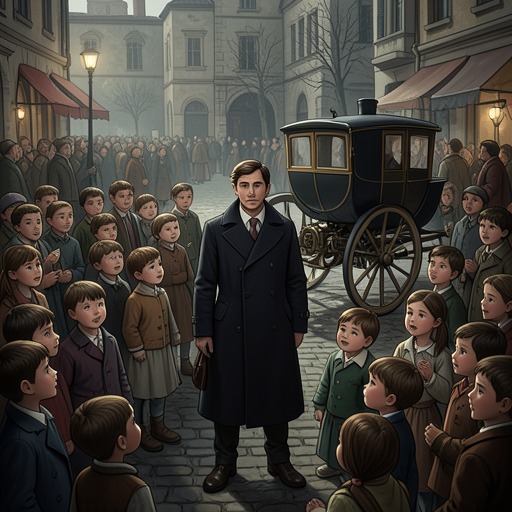
The narrator makes explicit that Pinocchio’s experience is part of a repeatable business. The Little Man travels from place to place in his carriage, gathering boys who dislike books and school through promises and coaxing. He carries them to Toyland, where they spend their time playing and making noise instead of studying. After continual play and no study have turned them into donkeys, he takes possession of them and sells them at fairs and markets. The narrator says that this trade has made him a millionaire within a few years.
This explanation widens the relation beyond a single encounter: Pinocchio is one of many children whom the Little Man recruits, transforms, and sells. His apparently sweet, milk-and-honey expression and habitual little laugh stand in pointed contrast to the coercion and profit beneath his work. The warning is not only that Pinocchio chose badly, but that an adult has organized that choice into a system for exploiting children. Their encounter turns the promise of freedom from discipline into another form of capture, with the market supplying the final measure of what the Little Man thinks the boys are worth.